Thursday, March 9, 2017

A Trip to Portugal - Lisbon and Sintra

     Tucked away in the southwest corner of Europe, Portugal is an unassuming gem that has not yet received its due as a premier tourist destination. Before this trip, all I knew about Portugal was what I had learnt in social studies class in school - that it was the home of  Vasco da Gama, the first European to land on India’s shores. With the promise of mild weather in the middle of February and a chance to go to the beach, a week long trip to Portugal was planned. This account also gives me a chance to showcase the photographic talents of my travel partner and all-around gentleman, Partha Chakrabarti.

     Mary McCarthy, the American novelist wrote "Any Portuguese town looks like bride's finery - something old, something new, something borrowed and something blue". To discover that for ourselves, we planned  a two part itinerary - first stop was the capital city of Lisbon and nearby Sintra followed by a road trip to the popular Algarve coast and back up to the monastery towns of Alcobaca and Batalha to complete the loop. 


     Befitting any European capital city, Lisbon has its modern side with excellent infrastructure, modern buildings and public transportation. But it is the Old town comprised of Alfama, Bairro Alto/Chiado and Baixa that exudes the charm of old world Portugal. 


      Narrow cobblestone roads lead up and down steep hills, tiny trams and funiculars jostling for space with tiny tuk-tuks whizzing past laid back pedestrians, spectacular tile work- azulejos- on walls of buildings topped with red terra cotta tiles, tiny houses squeezed next to restaurants serving bacalhau da bras, grilled sardines, arroz do mariscal and pasteis de natal. World famous retail chains sell trendy clothes and accessories next to old stores selling traditional painted ceramic roosters, cotton fabrics with intricate embroidery and lacework, tablecloths and purses made of cork, and tiles. 


     Tiles are everywhere is Lisbon. Elaborate nautical scenes painted on ceramic glazed tiles in blue and white, art deco patterns in brown and green, and biblical vignettes in red and gold adorn the walls of churches and office buildings alike. Whether it is the Cervejaria Trindade, a cavernous erstwhile monastery converted into a brewery and cheery beer hall or a fountain on the sunlit  terrace in the Jardim Julio de Castilho, art here is expressed not just on canvas or linen but also on ceramic tiles.

                                    
Walking is certainly the best way to explore the alleyways of this charming old town is to walk and alleys, stopping at the numerous mirador-s (view points) and gardens and the small kiosks for a quick sip of delicious port wine.
Pic: Partha Chakrabarti

Pic: Partha Chakrabarti

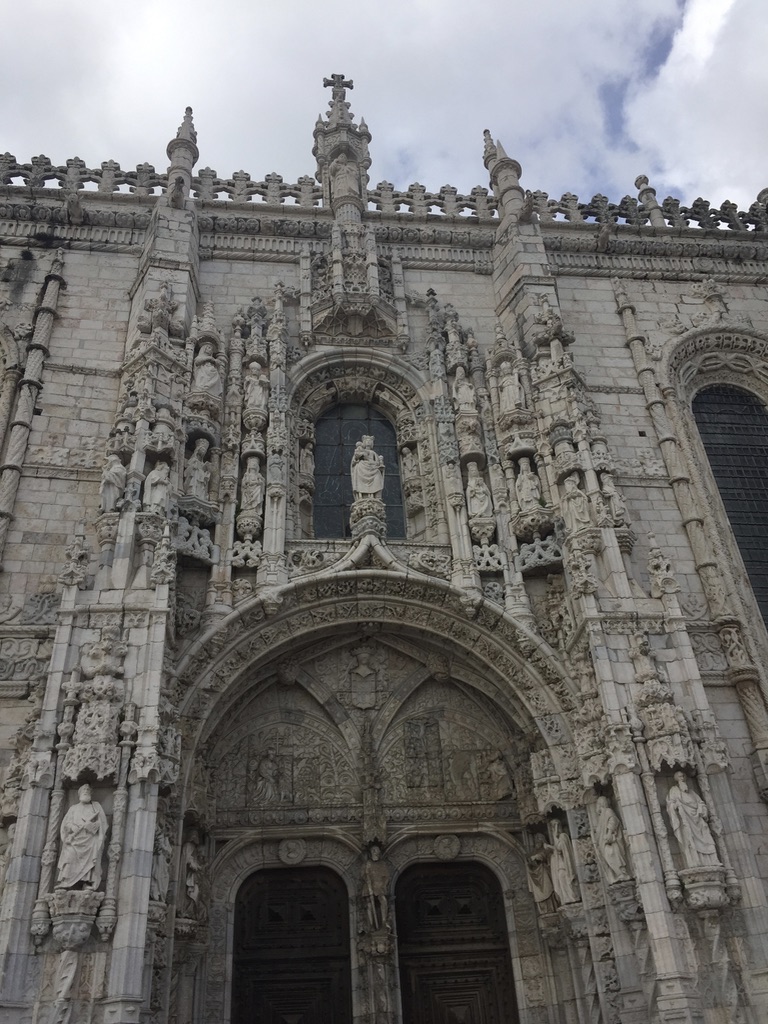
     With a 1,115 mile long coastline along the Atlantic Ocean, nautical exploration and naval might has featured heavily in Portugal’s history. The Caravel, a small highly maneuverable sailing ship along with two crows features in the coat of arms of Lisbon and the armillary sphere is present on Portugal’s flag. It was no surprise then that it was a Portguese explorer, Vasco Da Game who eventually succeeded in finding out the naval route to India.  He is held in high regard everywhere is Portugal, especially in Lisbon. He is entombed in a shrine in the magnificent Jeronimo’s monastery in Belem and a large statue of him stands alongside that of Marquis de Pombal, on the arch at the Prada de Commercio. The Marquis was who was responsible for the quick and successful reconstruction of Lisbon after a massive earthquake flattened the city in 1755. 

     Jeronimo’s monastery is a splendid example of Portuguese Neo-Gothic Manueline style of architecture. Named after King Manuel I under whom it developed in the late 14h century, this decorative style employs intricately carved stonework in portals, niches, columns and ceiling featuring maritime themes, armillary spheres, botanical and Christian themes as well as images and influences from newly explored lands.    


While the Praca do Commercio at the end of Baixa, a wide open square along the Rio Tagus, welcomes the visitors to this quaint and unassuming city, the Castelo do Sao Jorge stands guard at it’s highest point. 


Dating back to the medieval times, this Moorish castle has been used by successive  Portuguese royals as a residence and as a show of their military might. Though most of what remains now are ruins, this citadel complex offers some of the best views of the city of Lisbon. 


     A short 30 minute drive to mountains north of Lisbon took us to the town of Sintra. This small town hosts many of Portugal’s national monuments and has been classified as a UNESCO World Heritage site. Our destination has been described on the internet and guide books as 'Disney-esque', brightly colored castle on the top of a hill. 


      As the summer palace of the Portuguese royalty up until the early 20th century, the Pena Palace is an adorable dollhouse in bright red, yellow and blue, topped with domes, clock towers and terraces. Built in the Romantic style in the early 1800s, this national monument started its life as a chapel and monastery for the monks of the order of St. Jerome. After the earthquake of 1755, King Ferdinand II acquired the monastery and the land surrounding it and commissioned the construction of the present day palace. Moorish arches and domes are mixed with Neo-Manueline stone work on classic Gothic columns and topped with gargoyles. This is a fantasy land, where the best elements of art and architecture over two centuries is displayed with wild abandon. From the statue of Triton showing the allegory of creation to the arches of the Queen’s terraces, the beauty carries on inside as well. The Royal chapel with its exquisite alabaster carved altar, azulejos adorning every wall, stucco and masterfully painted walls and ceiling serve as phenomenal backdrop for exquisitely carved furniture and everyday objects.


A Trip to Portugal - Algarve and the Monastery Circuit

     The second leg of our Portugal expedition was a road trip from Lisbon south to the wild coast of Algarve. Driving on the well-maintained Highway A2 also called Via Infante de Sagres, we traversed the region of Alentejo, knowns as the 'bread basket of Portugal'. Rolling green hills dotted with yellow wildflowers lead to grazing cows and sheep. Groves of really tall trees as far as we could see. These unusual trees look like long sticks where trunks are stripped to a smooth brown surface and the branches form a tight ball at the very top, llke dark leafy green cotton balls. These are cork oak trees which yield cork, one of the most important exports of Portugal. The Alentejo extends all the way to the coast with small white washed houses with blue stripes and inviting beaches like  Cabo Sadrao and Arrifana.

     Our destination, Sagres is the south-westernmost tip of continental Europe. In summer, this is a popular beach destination for Europeans but in February we found it to be a quiet village with phenomenal views of cliffs jutting in to the Atlantic. Though the water was too cold to swim in, the sunny days gave us a relaxing break from sight-seeing and souvenir shopping.


     The monastery circuit of Alcobaca, Batalha and Fatima is well regarded among the faithful. Along with the religious significance, the monasteries of Alcobaca and Batalha have historical importance to the Portuguese people and have been efficiently preserved and maintained. The monastery at Alcobaca has a striking Gothic facade and a stark interior which reflects its main purpose. This was a house of prayer not celebration. It is also the final resting place of King Pedro I and his murdered mistress Ines Castro. 


     The monastery of Batalha however, dwarfs the visitor with its grandeur and architecture. Built to commemorate the Portuguese victory over the Spaniards in Aljubberra in 1385,  this monastery also served as a burial church for the Aviz dynasty of the Portuguese royalty. The central courtyard and the royal cloisters exhibit more of the Manueline architecture showcased in Jeronomo’s monastery in Lisbon. The wide pointed Gothic archways are layered with elaborate stonework featuring royal symbols of the armillary sphere and the cross of the order of Christ. 


     Given the importance of the Atlantic ocean in historical and present-day Portugal, we decided to end our trip on its coast. The fishing village of Nazare is quintessentially Portuguese. A well constructed promenade rings the beach and the town is settled around it. Rows of nets hold gutted fish and squid left in the sun to dry and little old ladies wearing traditional dresses and scarves sell roasted chestnuts and dried fish to snack on. 


The pace of life here is slow, as is it should be, calling you to relax and let your worries be swept away by the crystal clear green waters of the Atlantic. Here, as everywhere in Portugal, life is meant to be taken one day at at time, savoured like fine port wine and inhaled deeply like the fresh, salty Atlantic breeze.

Tuesday, January 17, 2017

Mallorca - our Mediterranean paradise

     The continent of Europe lies in the temperate climate zone, which means around the end of October, it is difficult to find a warm, sunny place within 2 hours of flying time from London. The trees were bringing out their golden wardrobe, the sun was beginning to doze off around 4pm and autumn was making its presence felt. Winter with its short, cold rainy days and long, colder nights was around the corner and a week in the sun was what we needed. A group of islands to the east of Spain caught our attention. While living in California, I had come across brightly colored Majorca ceramics and that was all I knew about Majorca, Spain. The weather forecast predicted average highs in the high 60s (Fahrenheit) and pictures of the idyllic blue green waters of the Mediterranean sealed the deal. We were going to Mallorca!

     Mallorca is the largest of the Baleariac islands in the Mediterranean Sea. It is a popular tourist destination with a modern international airport at its capital city, Palma de Mallorca. Going to a country where English is not the official language always excites me as it is an immersive experience in a language like no other. Over the years, I have tried, unsuccessfully, to learn Spanish but have only managed to know enough to read my way through signs, instructions and brochures. It was therefore very surprising see that at the airport, the signs were in English, German(!), Spanish and more Spanish, though not exactly. It was only later, at the hotel when I asked the receptionist about it, that I found out that Germans make up the majority of tourists in Mallorca and Spanish is not the official language. It is Catalan, specifically a dialect known as Mallorquin which sounds like Spanish but is not quite Spanish. 
     Palma  is the hub of tourist activity in Mallorca. It is a big city like any other with impressive infrastructure and facilities. But we were in Mallorca to to get away from it all. So we picked up the rental car and headed for  Cala D'or, a sleepy village on the island's east coast. 
     Highway MA-19 winds through the central plain or Es Pla as it is locally known. It is a scraggly almost arid landscape; not what one expects on an island. There was no verdant shrubbery, palm trees frolicking in the wind or the salty smell of sea air. Instead, gnarled, knobbly and stout olive trees stood betweens acres of reluctant grape vines in front of rocky hills jutting out of the ground as far as the eye could see, under a bright clear blue sky. As we were got closer to the coast, we drove through sleepy villages-it was siesta time after all- with modest white-washed houses with green shutters, red tiles and delightful names like Felantx and Santanyi. Here the landscape was agricultural with narrow roads flanked by large orange and lemon orchards. 
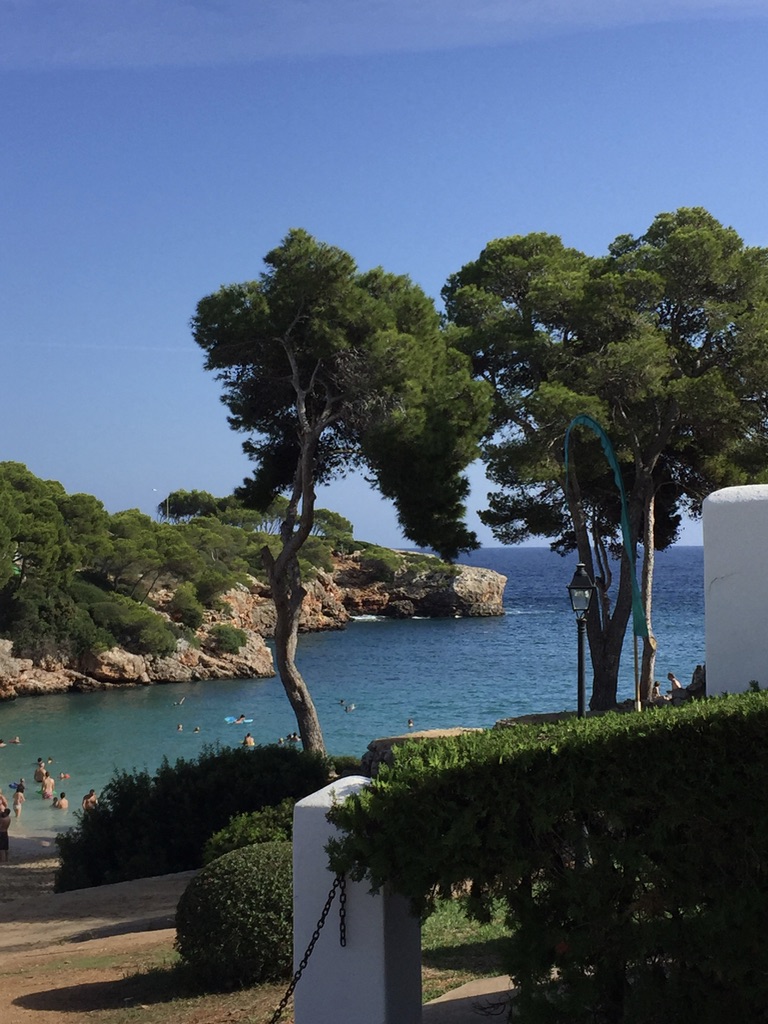
     Cala d'or was exactly I was hoping it would be. The town center is a maze of cobblestone streets with stores and cafes serving olives, iberico and serrano ham, pa amb oli with Mallorcan cheese and fresh seafood and padron peppers! We settled on paella for dinner and called it a night.


You don't need much when the water is warm, you are a short drive away from a fine sandy beach and the beach is not over run by people. To the sound of crashing waves and giggling children, add the call of the local fruit vendor selling pineapples and coconuts to the amused foreigners and the smell of fried sardines wafting from nearby cafes - it is a picture perfect postcard! However, there is always land to be explored and on one of the days, we took out the car and the maps and headed out to explore the rest of the island.

Driving west, we left Palma behind and climbed up and down the rugged mountain range of  Serra de Tramuntana. The entire mountain range is designated as a UNESCO World Heritage site, owing to its importance in the cultural and agricultural life of its settlers. Our first stop was  Port D'Andratx. Lore has it that this natural port was raided frequently by Turkish pirates and to preserve their town, the locals moved it inland to Andratx. Whether at the water or inland, this lovely town is surrounded by fortifications and boasts an impoing Gothic parish church.

 
             Driving further along the jagged northwestern coast of the island, the majestic blue green waters of the Mediterranean lie at the bottom of rugged formidable cliffs shaded by pine trees. This is not an easy landscape to conquer which makes it quite impressive to see fields of grapes, almonds and citrus here. The mountainous landscape is latticed with a network of dense dry stone walls known as paret seca made of irregular stones, diving the land into parcels. It is not uncommon to see these walls creep up along the cliff faces and carve out terraces on which the locals farm and tend to livestock like their ancestors used to. The Moors who came to this island in 902 AD are thought to have brought this knowledge with them from their native arid Africa. The technique is still in use here leading to agriculture being a vital part of the economy alongside tourism. This is unspoilt Mallorca at its best. Delightful towns of Estellencs and Banyalbufar and further north, Valdemossa beg you to stop your wanderings and take in the sprawling vistas, inhale the fresh air and leave your worries behind.


A couple more days of glorious sloth on the beach ensued and the day before we had to head back to reality, we decided to venture out into Palma. After walking the narrow lanes of the old town, we reached the star attraction, the Cathedral of Palma.
     The cathedral of Santa Maria de Palma or La Seu as it is commonly known is a Gothic Roman Catholic cathedral towering over the bay of Palma. Work on this cathedral began in 1229 AD under King James I of Aragon and was finished in 1601. However, work continued into the present century when the famed Catalan, Antonio Gaudi took up the work of restoring this behemoth of sandstone held together by arches and flying buttresses. The cathedral is adorned with Gothic style elements like gargoyles, railings and spires and the preference of horizontal lines over vertical. It is believed that 15 generations of architects worked on this cathedral, to make it the masterpiece it currently is. 


      Stained glass windows occupy the place of pride in any chapel, church, or cathedral. However, the Rose window on the eastern wall of this cathedral, 12 m across and studded with 1236 pieces of stained glass, is the largest and most majestic sight to behold.


Our time at Mallorca had come to an end. One week is not enough time to appreciate this island's people, culture and Nature. We bid adeu (goodbye in Mallorquin) to our Mediterranean pardise that has inspired the likes of Sands, Borges and Agatha Christie and promised we will be back, soon.

Wednesday, January 11, 2017

Hiking in Surrey - Gomshall Mill Pub & North Downs

There is no dearth of quaint buildings in Surrey. So far, the quaintest of them all has been the Gomshall Mill Pub. A 17th century riverside mill with original beams and floor boards, there is a tiny river that still runs through this building! Starting the hike up to North Downs on a misty December morning, the air was fresh, crisp and heady with petrichor (which means the pleasant smell when rain falls on dry soil - latest addition to my vocabulary; courtesy of my 12 year old son). The dried leaves were rustling underfoot, the moss shone a brilliant green. And at the end of a grueling 6 mile hike, a festive, cozy little pub awaited the muddy boots and sweaty shirts. The picture of the telephone booth outside the pub and that of the cozy interior was taken by my friend Amanda of the AWS Country hikes, who has been foremost in introducing me to this beautiful landscape of Surrey.


Hiking in Surrey - Windsor & Eton


     Windsor, a lovely town on River Thames, in south east England is home to Windsor Castle, a residence of the British Royal Family. It is also across the river from the town of Eton, which is home to Eton College. An independent boarding school for boys aged 13-18, Eton College was established in 1440 by King Henry VI and is one of ten 'public schools' in England. It has educated British Prime Ministers, aristocrats and scores of fictional characters including Bertie Wooster, Captain Hook and Mark Darcy. Walking along the Thames in a loop going from the Windsor castle, and along the various buildings that form the Eton College, I did see scores of fresh faced boys in coat tails rushing about with an air of purpose; whether genuine or forced upon them, I couldn't tell. We were constantly reminded not to take pictures which would show the faces of these boys. You never know which billionaire, President or King is paying the meagre £37000 and change per year to educate their sons here, to take over the world. I did, however take lots of pictures of the Crooked house, delightful pubs, swans frolicking on the river and pastoral landscapes that soothe the soul.
The Crooked House of Windsor, built around 1687, stands on an 'outrageous  slant' and is still in use.


The Windsor Castle

Do you know the way to...


What's in a name?....

....this describes it well.

Nothing else matters.