Wednesday, July 27, 2016

The story so far, Part II

What is a trip without a few bumps on the way? Reaching Logan airport with enough time on hand, we checked in at the Virgin counter. We got three boarding passes but there was something wrong with the fourth ticket - our son’s. Somewhere along the reservation pathway, the last name was spelled wrong on his booking. A simple slip to fix, you would think. Well, it took four employees, two phone calls and 30 restless minutes to sort it out. Then, except for a flight delay of 30 minutes, the rest of the evening was smooth sailing. The airline food and staff were extremely courteous and we had a good nap before it was time to descend into Heathrow airport. As we were gliding into town, a very wide Thames came into view. Then the London eye came out of nowhere and next to it, the Big Ben.In between the turns that the pilot was making because five other flights were lined up to land around the same time, I could see the greater London area laid out under me; a lot of green broken by twisting and turning roads and magnificent buildings- old and new. It took all of my self control to not scream in glee.

En route to the hotel, the jet lag hit all of us, except the ever-energetic 8 year old girl. We could not sit straight through the 45 minute drive to our hotel in Central London. One of the few times I forced myself to stay awake, we were driving on a leafy cobble-stone street lined on one side by a lush green park and on the other by a serious looking brick wall with fencing and security cameras on top. While we were trying to figure out what lay beyond the fence, we came upon a mass of people looking towards an imposing building. In between the sea of humans, I saw a row of red shirts and black hats and it hit me- this was the Changing of the Guard which meant we were outside the Buckingham palace!!! What an incredible sight. Though the traffic and tourists were all around, it was an amazing first look at the iconic building that is on the top of every tourist’s list. 

Driving up to the Threadneedles Hotel it was a kick to see familiar names like State Bank of India and Punjab National Bank, next to Lloyds, RBS and HSBC. This area is known as Bank for a very obvious reason. We managed to marvel at the hand-painted Victorian stained glass dome of the hotel lobby before tumbling into the room for a much needed nap.

Rested, refreshed and feeling human again, we set out for dinner in one of the typical London taxis to...


 ...Dishoom, an Indian restaurant in the Shoreditch area.


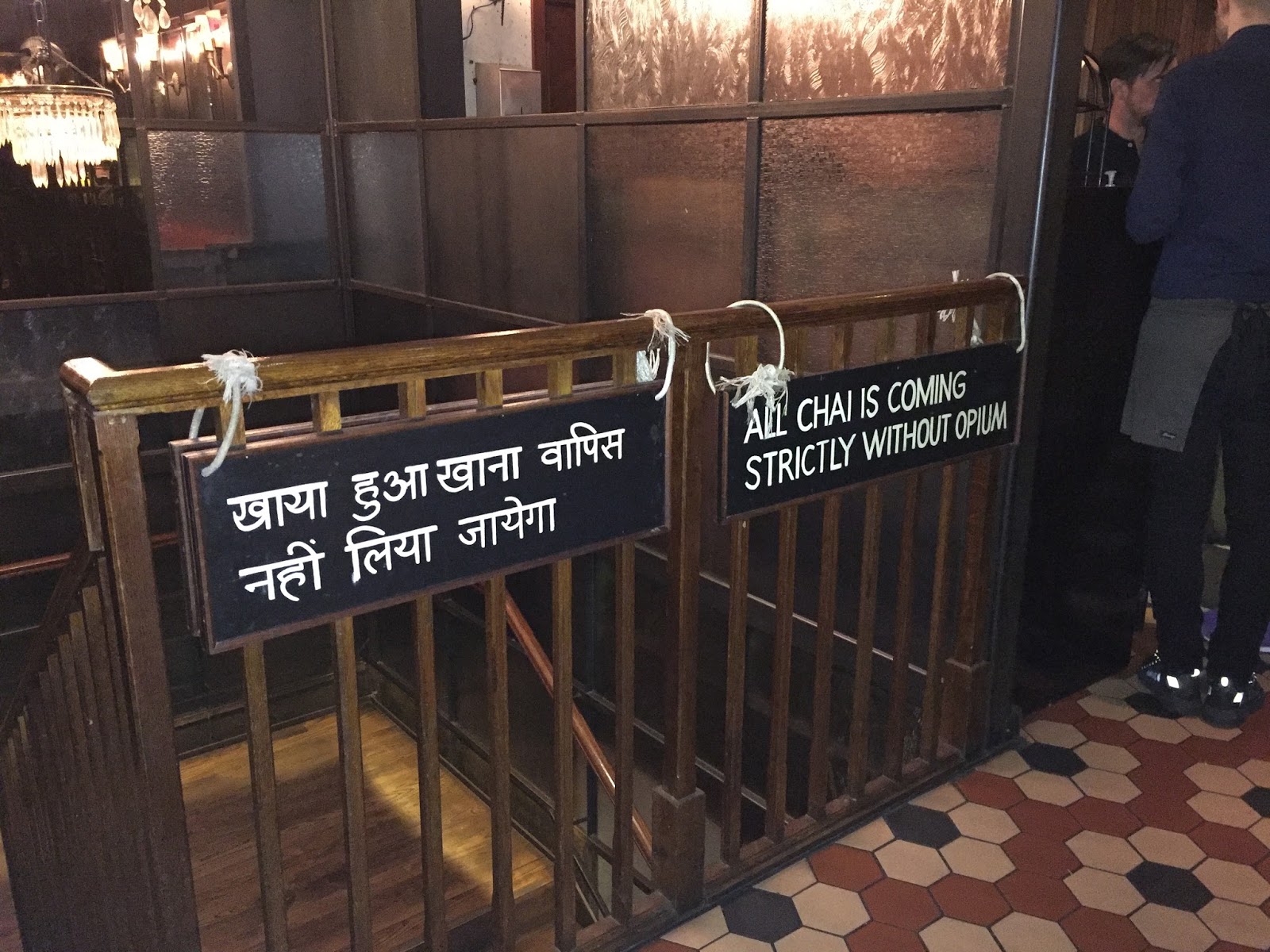
This popular and highly rated eatery is not just a nod to the Iranian cafes of a bygone Bombay but hugs the essence of nostalgia while comforting you. From the instructions written in Hindi, to stained mirrors lining the wall next to dark wood paneling, the entire place has a down to earth charm that feels like sitting down on your friend’s sofa for a lazy afternoon chai and snack. Settle into one of the booths with a Rexine sofa, pour some water from a wobbly steel jug into a steel glass and imagine what the food might taste like. Whatever you can imagine, it tastes way, way better. The menu is a listing of popular snacks like bhel, samosas, chillies cheese toast along with tried and true favorites like lamb raan, biryani and black daal. The flavor of the dishes is unabashedly Indian, the freshness of the ingredients and the skill of the chefs shines through.

This is the food you wish you made in your home and is served with a smile by a friendly and efficient staff. Dishoom deserves all the accolades it is getting and much, much  more.

Tuesday, July 26, 2016

London calling

The story so far, Part I

April 2016 was the two year anniversary for my husband at his work. As the challenge of learning and working in a new environment was wearing off, I sensed he was getting restless for the next thing. When we moved to the greater Boston area, we had decided that we would try to stay put till the kids went off to college. So he did the next best thing. He pursued an opportunity to work with the same company, in a different city, which turned out to be London, England! When we discussed this, another move albeit a temporary one, it took me two days to go from "Are you sure we should do this now? The kids are just settling in. It is going to be hard to come back to 8th grade for our son." to "Oh man, I cannot wait!"  

Our 8 year old daughter mirrored her brother's shocked reaction but changed it to a a hesitant "I want to go, but I will miss my friends. That is why I want to stay". However, my son was inconsolable. Given our history of moving every two years, he refused to believe that this was a short term assignment, a one year 'sabbatical'. We explained, cajoled, consoled threatened and ignored him for the next  48 hours. In the middle of the morning on the third day, my sweet 11 year old, texted me from his school bus, "I am ok to go to London, Mom".  And that was it. All four of us were going to be spending a whole year - July 2016 to July 2017 - in London! The possibilities, as they say, were endless.

Weeks of paperwork and trans-Atlantic calls followed. After the much-awaited assignemnt letter detailing the 'ex-pat package' was received, the priority was to enroll the children in a school. An exhaustive Google search revealed that admissions to local state schools (equivalent to public schools in the US that our kids were used to) in UK are done the fall of the previous year. I searched for schools in highly rated Local Authorities around central London as we were hoping for a city life experience for this year. I learnt about over-subscribing, wait lists, free schools and discussions on  Mumsnet.com forums about families moving into cities like Westminster, Kensington and Chelsea and paying exorbitant rents only to find out that their kids were bussed to schools in other areas. We did not want to take this chance and it was now clear that the kids will not be schooled in the local British system. We followed the path most expats take and decided to look through the International schools. The adage 'Seek and ye shall find' was probably coined with a divine conotation, but it is truest in the context of the modern day wonder of Internet. A few week's worth of searching and re-searching followed by telephonic conversations with always helpful directors and deans of admissions, followed by two days of intense personal meetings at the short listed schools and our children were enrolled in the school we liked, ACS in Cobham.
Now the kids were really excited. It was June and school work was getting wrapped up here and they were busy planning end of the year activities and parties. I had to answer questions like "Will I be able to learn badminton from a real teacher there?"(as opposed to mom)," Can I join the cricket team?", "Do they teach Shakespeare?",  "Will we have a big house?", "Can I take the bus?",  "Can I take the train by myself?",  "Will they have horse riding lessons? In the school?"
I was starting to wonder if they would be ready to come back after just one year.

This was going to be the year of travel and adventure for us. We had to remind ourselves that we had not won the lottery or struck gold and our travel plans would have to fit similar limitations in budget and time off  from work any other year. But the idea of being at the doorstep of an entire continent just brought out the Christoper Columbus in us and soon we had a must-visit list of countries. Using the school's holiday calendar and the work days off, we soon had weeks and weekends marked in a cheery pink with the intended destinations. Visa appointments for a UK work permit and a quick house hunting trip followed. Family was notified and the tickets were booked.  July 24 2016 was picked as the start date of our year of adventure. 

The day arrived hot and bright. The suitcases were packed and whatever did not fit in them had already been shipped. We were ready....London, here we come.


Thursday, February 4, 2016

All the Light You Cannot See by Anthony Doerr


 It is difficult to assign a title to a story in a way that it conveys the essence of the story and touches its core. Anthony Doerr has succeeded in overcoming this difficulty, brilliantly. All the Light WCannot See is a story about the physical absence of light - in case of its blind protagonist Marie-Laure LeBlanc - as well as metaphorical absence – in case of the other protagonist, an orphan German boy, Werner PfennigGrowing up on opposite sides of history, these two young people bring alive the sweeping tragedy of the Second World War and the horrible events in  Germany, Russia and France. Their lives play out independent of each other yet destiny brings them together at a crucial juncture, both of their lives and that of the War. This parable is sweeping yet intimate, panoramic yet microscopic. Told in two voices in alternating chapters, this is not an example that a novice writer might follow in terms of the theory of writing. The edicts of point of view, structure, character arc, scene-sequel etc are upended in favor of short chapters and shorter paragraphs and sentences that convey just enough information for the reader to make up his mind. Doerr appeals to all of the reader’s senses except the sighin scenes where Marie Laure's point of view is expressed and uses detailed, scientific enquiry when the story features Werner. The pace is crisp and the language, exquisite. The story gallops through the final years of the War yet finds time to languish in little alleyways and nooks and corners long enough to engulf the reader and transport them into its core. There is a surreal, almost magical nature to the entire story. If it were to be made on screen, it would be made in a sepia tone, with bright flashes of color in between to jolt the viewer out of their lassitude.  

The writer’s tone feels apologetic, at times, as if he is sad to tell you a story which may make you cry in the end. But he holds your hand the entire way and does not rush you; letting you enjoy the melancholy or ecstasy by your own timetable.  The secondary characters are  well-developedeverything and everyone is in the story for a reason. I would have liked it even more, if it was slightly shorter. The last three or four chapters felt extraneous, as if Doerr was having so much fun with his characters that he did not want to let them go. And I for one, do not blame him. 

Monday, July 8, 2013

The Art Forger by B.A.Shapiro


Pablo Picasso is believed to have said, “Every now and then one paints a picture that seems to have opened a door and serves as a stepping stone to other things”.  
The series of paintings titled After the Bath by Edgar Degas have inspired author B.A. Shapiro to do just that. She uses it as a stepping stone- rather, a diving platform in her book, The Art Forger to examine art, the artist and the value of art. What makes a piece of art valuable? Is it the art itself or the fame (or notoriety) of the artist? Can an artist get more value as a forger of a painting made by a famous artist while being ignored for her original work? How much do the experts really understand about what they assess and how much stock should a non-expert put in their recommendations and valuations? A struggling painter Claire Roth tries to reconstruct her shattered professional life and find answers to questions such as these in this brisk paced tale filled with intrigue and gorgeous details of place and time.

The main character is explored in detail and so are the myriad techniques of painting - Impressionist, classical and contemporary. The same cannot be said of the rest of the characters and the relationships Claire has with them.  The detailed analysis of paintings and painting techniques, of Degas himself, of the world inhabited by artists,critics and collectors tilts the balance of the story away from the minds of its characters. There is a love interest in the story which is portrayed in a hurried and callous way, along with a lot of secondary characters and events that are unrelated to the main story. The ending is abrupt and leaves the reader feeling shortchanged.

In spite of these shortcomings, The Art forger is a fast read with exacting details and descriptions of works of art that will make you want to find out more about the intriguing world of artists and art collectors. 

Thursday, January 17, 2013

Fishy.


“Something smells good, Mom”, my eight year old son calls out over the music of “The Adventures of Tintin” that he is watching with his five year old sister. The smell interrupts my husband’s Saturday night semi-fugue state, induced by old Hindi movie songs, ghazals and single malt Scotch. My industrial grade Viking hood is doing the best it can, but is no match for the heady fragrance of dinner, cooking in bubbling oil on its way to a heavenly state of golden brown crispiness. I am frying Pomfret.

Wikipedia says pomfret is a perciform fish belonging to the family Bramidae. It is found in the Atlantic, Indian, and Pacific Oceans. I say, they have no idea what Pomfret is.
Pomfret is my mother, announcing on a Saturday morning, that my brother and I were to watch out for and stop the local fishmonger  as he made his way through the neighborhood. The object of our attention for the rest of the morning was a short, dark man with round eyes and a quick smile. His bushy mustache apologetically made up for a receding hairline. He usually wore a mundu, a long rectangular cotton garment worn at the waist, and a shirt, with a scarf-like piece of cloth wrapped around his head.. He would ride into our alley on a bicycle with a basket tied precariously to the back seat. He announced his presence with a loud horn – the sound a cross between a duck’s quack and a broken reed. It was in this basket, over a thin layer of ice, under dark green banana leaves, that he presented the manna from local rivers and the Arabian Sea, occasionally his prized catch, the pomfret. It is an exciting day for us because cooking fish at home was a show of culinary bravery for my mother. She had grown up with strictly vegetarian, staunch Hindu parents and had tasted meat only after she got married .She was adventurous enough to cook fish but was not confident about buying or cleaning it. That was Amma’s job.  “Amma” is Malayalam for mother and to us, it seemed like the whole town called her Amma. She was a stern lady of indeterminate age, who worked in our house as a housemaid/translator/spreader of neighborhood information. As soon as the fishmonger stopped in front of our house, Amma was dispatched to do the needful. She wiped her strong and heavily wrinkled hands on her work cloth and walked up to him. She gave the man a once-over as if silently warning him against any mischief. Then she peered into the basket and moved back the banana leaves. She picked up the plumpest, whitest of the fish and gave it a good sniff. If it passed her olfactory test, its gills were pried open. If it was nice and pink inside, Amma gave the man a slight toothless smile and picked a few more. The care with which she picked fish for us made us feel like royal children, whose food was tested for poison before it was served. After the necessary payment was made, all of us followed Amma to the back of the house where she proceeded to clean and prepare the fish and hand it over to my mother for further processing.
Pomfret is my father, ordering fish for me, at every restaurant that we went to, even when it was the most expensive dish on the menu. The love on his face, having ordered the best dish for his favorite child, in my opinion, was returned with a grin on my face, when the waiter brought the plate of crisp golden fried fish, head intact, eyes open, garnished with red onion rings, chopped cilantro and a lemon wedge. For my brother and I, eating out at a restaurant was a luxury, a status symbol. To have a special dish ordered just for me was hence, a momentous achievement. Over time, the restaurants changed from a “dining hall” of five or six tables covered with white table cloths over worn out reddish brown carpets lit by shabby chandeliers to avant garde restaurants in five star hotels in Mumbai but the ritual never changed.
Pomfret is little fingers, peeling off the crisp skin to reveal firm white flesh held together by a skeleton of long bones. The fingers do not have find and remove tiny bones that hide inside other kinds of seafood. The fish has been fried whole, with two short slits on each side where the marinade of garlic, ginger and turmeric, green chilies, cumin, coriander and salt has made its way inside. The skin is a crispy golden brown, while the flesh has cooked in a fragrant steam of the marinade, giving it a flavor even the finickiest of eaters cannot ignore.
The smell reaches deep inside me, taking me back to the land where I grew up, thousands of miles away from this beautiful prairie that we now call home. It is the link from my childhood to the life that I am trying to create for my children. It inspires me to make memories with them, which they can turn to, when they grow up. I hope that this fine specimen of the Bramidae family thrives and multiplies for generations in the saline ocean waters so that my children can share the joy of a perfectly fried pomfret and steaming rice with their loved ones, for years to come.

Monday, January 14, 2013

A different shade of green


     A line of old Ambassador cars greets you as you step out of Kochi International Airport. This is one of only two states in India where these rotund and sturdy cars of the 1980’s have not fallen out of favor. Sleek elegance, modern amenities and power are aspects not associated with this car, but their drivers do not seem to mind. Well-maintained city roads direct the fast and unruly traffic and billboards advertise mega gold jewelry marts and silk saree emporiums. As you make your way towards the rural interiors, you remember the caption on the tourism department’s brochure – Kerala, God’s own country. Roll down the windows - use your biceps, no power windows here - and inhale the gorgeous sea air, there is no doubt you are in a tropical paradise.

     No matter what the season, there is equilibrium between the water content in the atmosphere and the air so that there is just enough air to let you breathe comfortably but the humidity makes it thick enough to be palpable. Paddy fields, with thick sheaves of rice, sitting in puddles of water put on an intense display of green. Acres upon velvety acres are tended to by hand, mostly by women, who try to coax rice, the life blood of the region, from this stubborn plant. The straight, brown trunks of the coconut trees rise up tall with a head of lush long, yellow–green fronds. It is capped off with a big bunch of coconuts and stalks of small yellow fragrant flowers. The soft, flimsy stems of the banana plants support  wide leaves and big bunch of fruits which are loved by humans and animals alike. Elephants are the workhorses here, carrying loads of timber from forests with the same aplomb as serving in religious festivities in temples, decked in gorgeous livery. 
     Then, there is the water. Tucked away in the southwestern corner of Indian peninsula, Kerala has a long coastline along the Arabian Sea. This is the landing ground for the majestic monsoon, which gathers up from the Indian Ocean, drenching the land for most of the year. Water collects everywhere; in small ponds, lakes and gurgling streams, filling up with water lilies and buffaloes in the blink of an eye. Three large rivers traverse this small state spilling their energy onto the shores and into the people. The vast waters of the Arabian Sea to the west of the land mass form the perfect backdrop for the tiring sun to rest, every evening, bathing the coconut groves and rubber plantations in a surreal golden hue.
The houses are modest, complementing a population that is cultured, conventional and hardworking. One or two story concrete buildings, painted in light colors with red tiled roofs. A compound wall marking the property line and a gate, usually an intricately welded iron one, making you pause before you enter. The yard is dirt with bushes of brightly colored flowers along the walls. Hibiscus, gardenias, jasmine and roses vie for attention under the tall presence of coconut palms and jack fruit trees. The scent in the air is primal, of a happy balance between nature and its human tenants. Technology and the progress that modern amenities promise have found their way to this remote corner of land but the culture of respectful indulgence in nature’s bounty has created a harmonious lifestyle for its population. With as many people wearing the latest fashion in jeans, skirts and pants as there are men wearing the cotton mundu and young girls wearing the silk white and golden sarees, God’s own country is not stuck in time. She is relishing time, as it flows like the deep waters of the Periyar river towards the sea.